Sunday, April 6, 2014

Los Angeles is Burning

Growing up in the “Los Angeles private school circuit” this book is surprising relatable. Now I don’t exactly know how that makes me feel, because while reading this all I can think of is “Wow these kids are such assholes”. Am I a huge asshole? Are all my high school friends assholes?  Now I’m not so sure, and I guess the point of this blog post is to work through those two questions while looking at the text. I apologize in advance for an extra long blog post.

So I guess I should clarify what I mean by “this book is relatable”. First off, I’m nowhere nearly as wealthy Clay and his friends, and I have never been involved in drugs the way that Clay and his friends are. That being said, friends/peers/acquaintances of mine, fall into one or both of those categories. I have, however, been to most places that Clay describes in the book; in fact my best friend’s family has a house in Palm Springs. I’ve had late nights at the Du-Par’s in Studio City after the house party that we all left because it “just wasn’t good”, I’ve driven all the routes that Clay’s driven. But enough about me.

Clay’s issues stem from a broken family that tries to cover up its faults with money. The drugs are a way to cope, to escape. This image is all to real; I’ve seen several kids, with parents who have more money than anyone can imagine, use the never ending supply of money to fund their “perma-high” of weed, cocaine, and Xanax. I see the meaningless sex that Blair, Alana and Kim discuss (everyone seems to be sleeping with everyone) as kids trying to break away from their boring, wealthy, white, heterosexual parents who represent something that they don’t want to grow up to be. The drugs are an embodiment of that as well.   

Now what do I make of all of this? These kids are real. The superfluous wealth is real. The designer clothes are real. The designer drugs are real. So are Clay and his friends the lost generation? Maybe. In 1985 (when this book was published) they were. Would they be considered the lost generation today? I don’t know. All the people that are described in the book, the people who I know real life analogs for, aren’t considered lost (at least not most of them) they’re just considered hipsters.

So if we’re doing the same things that kids did 30 years ago but 30 years ago they were lost, and today we’re hipsters, what does that mean? Is it just a change in definition, or is there something I’m missing?


-Ameet

Socal Stereotypes

“and is [varying degree of] tan and has [varying degree of] blond hair”


I haven't counted, but I would be willing to bet that Clay describes over two-thirds of the people he sees in such a manner. This is isn't Clay's choice, but the author's doing– he writes a story with incredibly over used and unrealistic Los Angeles/Southern California stereotypes. Almost every character is tan and blond, and the tan-ness of said persons is often the first thing Clay describes. The novel plays further into the surfer stereotype when Clay describes “some surfer.” Is everyone in Socal a tan, blond, surfer? No. Is everyone in the novel a tan, blond, surfer? Mostly. Does Less Than Zero play on many other Socal stereotypes? Definitely.


According to the novel, we go to the University of Spoiled Children and our rival school is U.C.R.A. Everyone in Southern California is rich and good looking; Clay nonchalantly mentions some kids who he may or may not have known in high school that have turned out to be semi-famous actors or models. The adults are obviously rich and work in the entertainment business. Clay's psychiatrist also makes bank, drives a 450 sl, and lives in Malibu because, of course, it's Southern California.


These are certainly not all the stereotypes in the novel, but these are so exaggerated and prevalent that it makes me wonder why Brett Easton Ellis presents the novel in such a way. As Ellis was born in Los Angeles, it certainly isn't a case of an author using stereotypical images to portray the characters simply because he doesn't know better. Does he use these stereotypes as a criticism of Southern California lifestyle, or just the lifestyle Clay and his friends live?

Andrew T

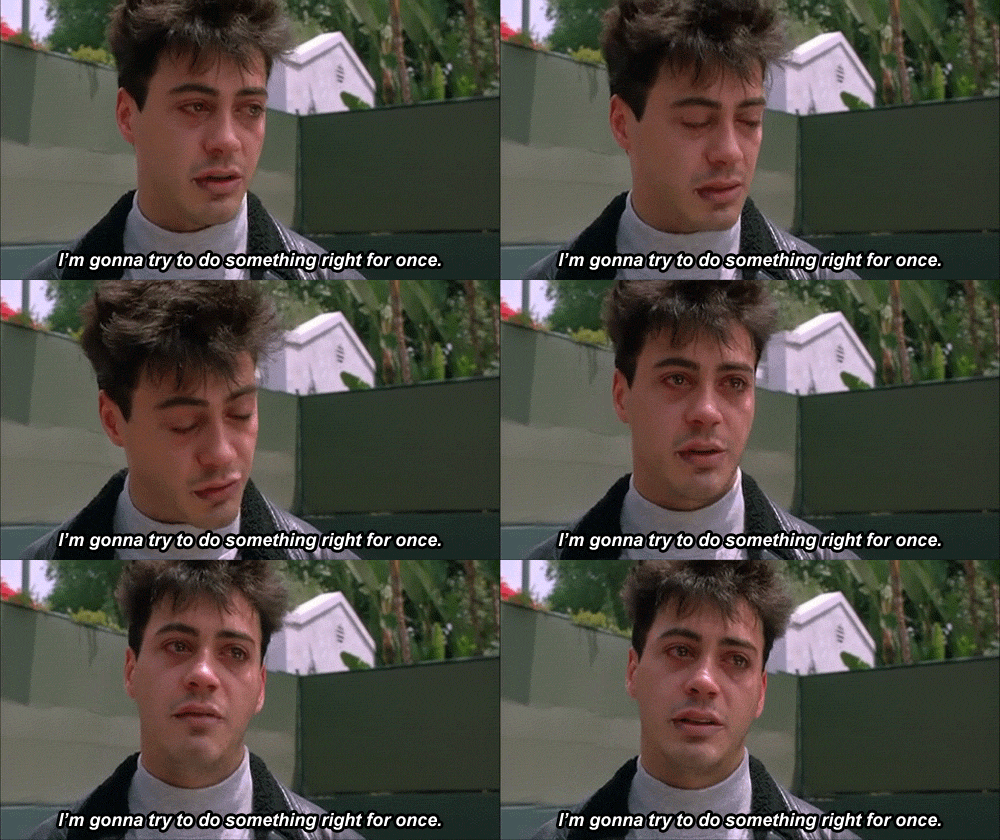
"Waaahh" - Clay

Reading Less than Zero is an odd experience. I just watched the documentary Bridegroom earlier today (and cried like crazy) and it has this view of Los Angeles and Hollywood and California as an epicenter of acceptance where gay men and other outsiders can go and be accepted. They are places that stand in opposition to the shallow and judgmental “wholesomeness” of Middle America and instead celebrate difference.

In Less than Zero, though, Los Angeles is the epicenter of shallowness where tolerance has run wild, nothing seems to be off limits, but at the same time, everyone seems to feel comfortable judging one another for his/her/their surface features.


In reality, it’s obviously a bit of both. What bothers me is when people who live here adopt extremist views claiming that it’s almost exclusively the latter, but that they are the one disillusioned observer who watches it all from the corner of the party before partaking in the activities because you know, why not when nothing matters? I feel like I know lots of people who read literature like this and watch angsty movies like Lost and Translation and then pretend like everything around them is more shallow and grotesque than they are. The division between that self, that individual, and the otherness of their city is bullshit. And the angst that’s produced by that division is profoundly annoying to me. It reminds me of the “I’m not like other girls. I hate drama.” attitude, but more classist. It’s like “I’m not like the other rich kids, I have this never-ending internal pit of angst and bitter observation that stands in contrast to their shallow focus on my lack of a tan.”

by Jacky Jack Snack Attack

Bonus video/song: https://www.youtube.com/watch?v=3LLXx3o5PC8

Overwhelming Blandness

One thing that jumped out at me as I began reading Less Than Zero was the unique style and tone of the book. Even the most ordinary of events is tinged with an overwhelming bleakness. Events that are less ordinary and more jarring are treated in the same offhand way as are the ordinary events. The ordinary and the extraordinary are bleak in the same way.

This overwhelming feeling is accomplished through Ellis’ unique style. One particular thing I noted was the use of long drawn out sentences, containing seemingly unimportant descriptions of events spliced into minuscule parts.

For example: “Kim gets lost and forgets the address and so we go, instead, to Barney’s Beanery and sit there in silence and Kim talks about her party and I shoot some pool and when Blair orders a drink, the waitress asks for I.D. and Blair shows her a fake one and the waitress brings her a drink and Blair gives it to Kim, who drinks it down fast and tells Blair to order another one” (99).


The sentence is broken up with “ands” instead of commas. This gives the sense that each small event holds a lot of weight, and the weight from each new event and “and” piles up to form a tone that is heavy and overwhelming. Yet the diction is quite bland and matter-of-fact. Thus, it seems that it is the bland meaninglessness and seeming feelings that Clay has of being trapped in an inevitably insufferable life that are so overwhelming and difficult to grapple with.

"People are afraid to merge" and Lack of Drive

Clay and everyone else in Less than Zero are all wusses. Their lives can be summed up in the first line of the book, “People are afraid to merge on freeways in Los Angeles” (9). They all stall when they are supposed to merge and move on like normal people with their lives, take risks and change themselves for the better. They have stalled for so long that they can't even comprehend how to move forward anymore, evidenced by Clay's apparently unexplainable fixation with merging on freeways. I read Less than Zero the first time over winter break and loved it (perfect holiday reading, clearly), but on the second go-around, I realized that while I still enjoyed the book, I lamented the lack of a character to root for. Knowing Brett Easton Ellis, though, this case of the missing hero was probably intentional.

The only sign of strength that I could attribute to the characters is how good they are at dismissal. Rip does cocaine on a mirror; his vice is literally staring him in the face, yet he doesn’t even flinch at his grotesque reflection. The mirror is just another piece in his life, a tool for his preferred method of escape.


Sometimes I also wonder if this universally miserable existence is caused by Los Angeles itself. After his one-night stand with Griffin, Clay runs into Griffin’s maid, who doesn’t react to his presence at the crack of dawn. Trent’s maid might as well be one of the struggling teenagers at the center of the novel with her health history. Both maids are foreigners who must have had to get used to all this debauchery in order to not only condone but also participate in it. What is it about L.A. that is so destructive to the human conscience and motivation to thrive?


                                           I sure hope you do.
-Ly

Real (not really)

     I can't decide whether the characters in this book are the fakest (sp?) or realest people I've ever encountered. They are brutally honest in the most negative sense of the word. It matters not who hears the conversation;  Clay accuses his thirteen-year-old little sister (?!) of stealing a quarter gram of coke from his room while in the car with their mom, and Kim and Alana and Blair openly discuss their promiscuous sex lives in the presence of Clay, Blair's boyfriend. The thing is, no one tries to hide their vices because everyone knows he or she is just as guilty. Clay puts it perfectly: "I realize for an instant that I might have slept with Didi Hellman. I also realize that I might have slept with Warren also... They probably already know" (28). If you think about it, environments that open are hard to come by. Are you that honest in your relationships? Probably not.
     But that's okay, because these people aren't actually honest-not exactly role models to look up to. The lifestyle they promote is a way to deny reality, drowning it in drink or soaring above it on the high of drugs and orgasms. Clay is uncomfortable-in fact feels physically nauseous-when he is directly confronted with his companions' underlying issues, like Muriel's annorexia. He also belligerently avoids discussing any real problems with his shrink. Hands shaking, he'd much rather pop a Valium and relax into sleep.
 So ultimately, "actions speak louder than words" (blech sorry for the cliche, it's just super accurate for the situation). What first comes over as honestly masks a more deeply-rooted kind of falsehood that is very disturbing.  But why the superficial openness? Is it sadistic or are they lonely and desperate for attention? I think Clay's preoccupation with sunglasses and people looking at him and smiling points towards the latter.

Maybe They're Just Cold

While it might be permanently sunny in Brett Easton’s Less Than Zero, Clay and his friends each seem to long for warmth and heat. Although a Los Angeles winter is drastically different compared to a New Hampshire winter, Clay doesn’t seem to get any “warmer” over his winter break. His outdoor surroundings are warm, yet the hot winds and sun do little to Clay’s pale complexion. Inside, “…the air conditioner is on…the walls are still white…and it’s beginning to get really cold in [Clay’s] room.” Friends, such as Daniel, wear “sunglasses and a black wool jacket and black jeans,” and Trent wears a “red-and-green-plaid scarf wrapped around his neck.”

Sure, evenings in Los Angeles can get a bit chilly, but usually not on days hot dry days like this one. Everyone wears attire that is indicative of weather colder than what it is in actuality; almost as if they reject the warmth that Los Angeles gives.


They never remove their sunglasses: “My mother and I are sitting in a restaurant…and still has her sunglasses on.” They get fake tans that don’t even require light, instead dying their skin. This sort of paradoxical world that Easton creates is interesting, considering that maybe the weather has something to do with so many of characters' self-destructive ways.