Sunday, April 20, 2014

Two Thumbs Up for "Down the Rabbit Hole!"

I attended “Making Up is Hard to Do” and “Because I Said So.” I will blog about “Making Up is Hard to Do,” but I want to briefly mention an interesting observation made during the Q&A of the other panel.

Two of the papers in “Because I Said So” presented back to back with completely opposite arguments. One student wrote about Four Lions, a dark comedy about unlucky terrorists; he proposed that ideology is most dangerous when it is brought to life in its most extreme form by a follower’s overzealous, uncompromising belief in it. The next presenter, however, made a case to support ideology’s ability to free its followers from oppression, as demonstrated in Kindred. What we learn from this seeming contradiction is this: what matters is not the vehicle for your experience, but how you use that vehicle that shapes your experience and what you learn from it.

Back to the first panel. Three of the papers proposed interesting ideas about the identities of their respective protagonists. One student wrote about Billy from Slaughterhouse-Five, claiming that he is a Christ-like figure. She believes that he has a high capacity for empathy and many other qualities that Jesus possessed. However, she did not use this comparison as a way to elevate Billy’s character; on the contrary, she used his similarities to Jesus as evidence for Vonnegut’s anti-Christian ideas. That is, if humans only pursue moral action in response to fear and threats, then they are not inherently good. Another student defended the characters in On the Road, suggesting that they are not rebels, but reformers wishing to improve their narrow-minded, nuclear family units. The third student gave an interesting analysis of the use of green and blue colors in The Great Gatsby to signify Fitzgerald’s loss of his Irish identity to the melting pot of America and the clash between Eastern and Western values. I think all three presenters did especially well in offering unique perspectives on well-known, well-analyzed works (yay for alliteration).

--Ly 

More Power to Ya

In addition to my own panel, I attended the Keynote, “Tell It Like It Is”, and “More Power to Ya!” For the blog, I’m going to focus on “More Power to Ya!” because I enjoy unnecessary exclamation points.

“More Power to Ya!” was a gender-themed panel that included a positive assessment of Princess Mononoke as a feminist text, a defense of Jack Kerouac’s gender politics, a Butlerian reading of Hitchcock’s Lifeboat, an examination of/advocacy for powerful yonic imagery that rebels against Freudian thought, and a analysis of the victimhood of female characters in V for Vendetta.

I really liked the presentations for the most part, but a lot of them left me with questions. For example, the presenter of the Lifeboat character seemed to me to imply that the gender representation in the movie was progressive/empowering because the female lead was able to get what she wanted by oscillating on the gender spectrum, becoming more masculine or feminine depending on the situation. However, the author of the paper didn’t address the fact that there is a long-running trope of negatively defined female characters that become more or less feminine to manipulate the men around them. And the author of the Princess Mononoke paper seemed happy with the egalitarian couples in the film wherein which both members behaved in a traditionally masculine way, but didn’t address the problematic aspects of potentially repudiating femininity in the process. The presenter on yonic imagery was a friend of mine and she devoted a whole paragraph to explaining why her paper would only address the needs of cisgender individuals, but I was really curious whether/how a trans* author could use sexual imagery to empower themselves. Of course, my friend is cisgender, so she couldn’t really provide that perspective, but it still left me curious. Which is a good thing.


Anyway, I really enjoyed seeing friends/classmates/acquaintances present at panels.  

- Jack

Anti-Social Novels

This past week, I attended “My Own Worst Enemy” and “Reality Bites.” I am going to blog about the second panel.

I found the papers on this panel extremely interesting. The paper on In Cold Blood especially caught my attention—the idea that nothing can ever be 100% representative of reality is something that I have thought about before, and I was delighted to hear about it in the context of the book. Another paper, on Into The Wild, also interested me. The student who wrote it pointed out that to be able to survive in the wile, Chris McCandles actually had to rely on things produced by society—he is always carrying a backpack full of things and uses cars to get around.


What I found most interesting, though, came in the question portion of the panel. The idea of an anti-social book came up. One student, while talking about his paper—written on DeLillo’s Players—said  that sometimes a book—his in particular—is too busy reflecting on itself that it fails to reflect anything about the outside world, and thus, fails to connect with the reader. He says this makes it “anti-social.” The student concluded that there is little value in this, and wondered why the author bothered to publish it if it was a book written basically only for himself.

--Francesca

The Life of an Individual

The two panels I attended were called “Doomed to Repeat It” and “There Will Be Blood”. The panel I will focus on for my blog post will be There Will Be Blood.

The panel discussed the issue of blood through many different lenses and interestingly enough, finding one common theme was not as apparent as it was in the panel I presented on, and the other panel I attended. Yet, by the end the panel had established a common theme that came from the question of how the characters in each one of films or novels present a skewed reality. One answer that I found particularly interesting came from Isabella who wrote an essay on Bloody Sunday. She discussed the manner in which both the protestors and the military had entered the “battle” with a certain perception of how the protest was going to end. She claimed that due to this preconceived notion of what will/should happen the events transpired in a much more violent way than they could have.

When asked about the skewed reality she responded that if you think about it, it could be argued that every experience and interaction we have as human beings is framed in a somewhat subjective manner. Nothing is truly objective. I tried to think about that in relation to the texts we read this year. In the Virgin Suicides the narrators are completely skewing the events by making the Lisbon Sisters into these hyper-sexualized objects, in Black Swan the camera presents a certain subjectivity and skewing of reality through the use of mirrors and the physical harm that Nina inflicts on herself. We can make these statements about every work we’ve read.


So maybe Isabella was right. And if she is right, is there anything that we’re supposed to do about it? Probably not. You live your life through your own eyes, so your experiences are entirely your own. Nobody else will share the same exact experiences as you, and that’s what makes each experience so unique.  

-Ameet

TO Conference!

I attended Dear Reader and Part of Your World. (Props to Nim and Becca, who were both fantastic!)

I'd like to discuss the latter. The papers in Part of Your World focused on the impact of environment on an individual. Essentially, it addressed the latter part of the infamous "nature vs nurture" debate and analyzed each character with the assumption that they are largely a product of their environment. However, what happens when we make a different assumption and consider them to be driven by their natures? What, if anything changes about our understandings of a character, and is it even possible to analyze one if we just chalk everything up to human nature?

For example, Becca wrote on Eugenidies' work and claims that the Lisbon girls are, "manicured, regulated, and ultimately violated" because of the community's "sense of entitlement to and regulatory power over the area." What if the girls, by their own nature, chose to withdraw from the community because they were not comfortable in it? The narrators do tell us that the girls usually kept to themselves, and the boys' creepy fascination with them began long before any signs of trouble. Could it not be possible that the girls were naturally reclusive and wanted to get away from the attention? However, if we do use this lens, it seems that there is suddenly a whole lot less to analyze.

Similarly, if we consider J. Alfred Prufrock to be driven by his inner nature, then Eliot's poem becomes an almost comical narrative about the unfortunate (and nonexistent)  love life of a very shy, indecisive man, instead of a criticism of modernity, as Lenara argues in her paper. I guess there was a good reason why all five members of this panel chose to focus on "nurture" instead of "nature."

Saturday, April 19, 2014

A Scientific Aside

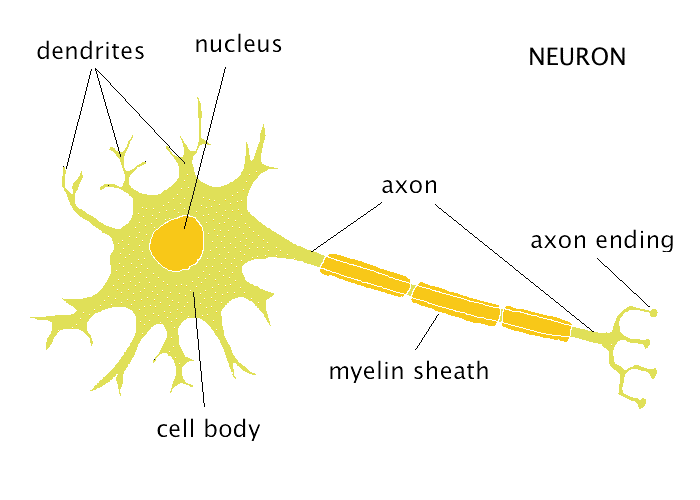
For anyone interested in science, and more specifically brains, this is an idea I thought of during a bio lecture on neuron activity the day after the conference:

So, the basic structure of a neuron is that there are dendrites branching off a nucleus and a long axon extending out of that nucleus and then a synaptic space over which neurotransmitters diffuse, essentially connecting one neuron to the next.
When we have a thought, or idea, or reaction to stimulus, an action potential sprints down the axon and causes the neurotransmitter-carried communication across the synapse. Right after the action potential comes the undershoot, which essentially inhibits another action potential from occurring too soon after the first. But by the same token of ion concentration gradients by which it functions, the undershoot also inhibits the action potential from running backwards to its source. Action potentials may run in one direction, and that is forwards.

Now Prof. Kemp mentioned that in physics, a key concept is that time can also only move in one forward direction. If time is just a construct of our minds (and who is to say it isn't? There are no outside sources of intelligence that can disprove that theory, especially because all machines that could empirically test for opposing evidence would have to be designed by humans, who inherently carry the belief that time is forwards-ly linear, which would affect the design of the instrument), then the undershoot that follows the action potential is the mechanism by which time is prevented from running backwards. And deja vu, when we have the eerie feeling that we have experienced something before, would be a malfunctioning interaction. 

Of course, this is just a theory I hold. There is no research into the subject that I know of (how would anyone even study that concept?), but guys...what if that means the key to time travel is inside our own heads? What if we could figure out how to inhibit that undershoot and control the action potential so that all stimuli run back to the source? What would time even look like?

Sorry. I completely dorked out and I don't even know if any of that is coherent because I got super excited while writing it. But, like, wow. Brains are just the coolest things ever.
-Becca

Circular Reading

I attended the "Doomed to Repeat It" panel and "My Own Worst Enemy." I'm going to discuss the former. 

Narrative style, time travel, and truth in literature. A casual discussion. But really it kind of blew my mind, especially after all the different "worlds" Prof. Kemp drowned us with in the introductory lecture. My mind was already on a metaphysical path; the panel's preoccupation with recursive time and patterns and history (both personal and public) only worsened that trend. I'm going to relate this idea of "circular reading" that Matt brought up to Walter Benjamin's Angel of History. Apologies in advance if it gets sloppily abstract.

A brief synapsis: Matt wrote his paper on A History of the World in 10 1/2 Chapters, wherein the author, Julian Barnes, presents different events of history out of order and narrated from several points of view. Apparently, the result is depressing, and every chapter ends with destruction, death, etc. Except the last; the last advocates that love is the cure for all the mess that happened before. Matt proposed that instead of taking the novel at face value and reading it linearly, it should be read out of order, so that that last message of hope might be dispersed throughout the despair that is the rest of the novel.

Benjamin's angel can only read time linearly because he faces the past and ignores the future. The result is that all that over-quoted "wreckage" gets "piled at his feet." But if he only learned to view things more circularly, considering the future in how it factors into the past, then that wreckage could be alleviated, much as the despair in Barnes' book is lightened by hope. My basic idea I got out of it is that circularity is not just a way to read literature. It is a way to approach all time lines, including our own. But it's damned tricky to do, in my opinion.

-Becca